Key points at a glance
- The Impressum follows § 5 ECG (E-Commerce Act). Instead of a chamber, you state your professional title, the country that awarded it and the MTD-Gesetz 2024 as your professional law – with a link to the RIS.
- Registration in the Gesundheitsberuferegister (health professions register) is a prerequisite for practising; the registration number in the Impressum is voluntary but builds trust.
- The Offenlegung (disclosure) under § 25 MedienG is part of it too; for a plain practice website, the short version is enough.
- Referrals, medical reports and descriptions of complaints are health data: forms and online booking need secure technology and a matching privacy policy.
- Photos and exercise videos with patients only with written consent – and clear cost information for patients of non-contracted (Wahl) physiotherapists.
This post is general information and does not replace legal or tax advice. Rules change – check details with your chamber, your professional association or your tax adviser.
The Impressum under § 5 ECG – without a chamber
Every practice website is an “information society service”. § 5 Abs 1 ECG (the E-Commerce-Gesetz) therefore requires certain information to be easily and directly accessible – in practice, an “Impressum” link in the footer of every page. For self-employed physiotherapists, it looks like this:
| Item under § 5 Abs 1 ECG | What you enter as a physiotherapist |
|---|---|
| Z 1 Name | Your name, academic degrees and, if applicable, practice name (e.g. “Physiotherapie am Kai – Anna Berger, BSc”) |
| Z 2 Address | The address of your registered place of practice (Berufssitz) – even if you mostly do home visits |
| Z 3 Contact | Phone number and email address (a contact form alone is not enough) |
| Z 4 Company register | Only for a GmbH or registered partnership: company register number (Firmenbuchnummer) and court |
| Z 5 Supervisory authority | The Bezirkshauptmannschaft (district authority) or Magistrat (city authority) of your place of practice (see below) |
| Z 6 Professional law | Professional title, awarding country, professional association if any, reference to the MTD-Gesetz 2024 |
| Z 7 VAT ID (UID-Nummer) | Only if you have one – physiotherapy treatments are exempt from VAT |
The most important difference from doctors: there is no chamber for physiotherapists. So you leave out the “chamber” line from a doctor’s template or replace it. If you are looking for the details for medical practices, see the Impressum guide for doctors; there are separate guides for psychologists and psychotherapists.
Professional details: register, professional title, MTD-Gesetz
§ 5 Abs 1 Z 6 ECG applies to everyone who is subject to professional law – including you. These points belong in the professional block of your Impressum:
- Professional title: “Physiotherapeutin” or “Physiotherapeut” (female/male physiotherapist) – the protected title under § 1 MTD-Gesetz 2024, the Austrian act governing the higher medical-technical services. Academic degrees such as BSc or MSc go next to your name, but they don’t replace the professional title.
- Awarding country: usually “Österreich” (Austria). If you completed your training abroad and had it recognised in Austria, name the country of training and the recognition (e.g. “awarded in Germany, recognised in Austria”).
- Professional law: “MTD-Gesetz 2024 (MTDG), BGBl. I Nr. 100/2024” with a link to the current version in the RIS (Austria’s legal information system). The ECG explicitly requires a note on where the professional law can be accessed.
- Gesundheitsberuferegister: without registration, you may not practise; self-employed practitioners register with Gesundheit Österreich GmbH (GÖG, the national public health institute). The register is public, so your registration number is visible there anyway. It is not an explicit requirement in the Impressum, but it is a good sign of trustworthiness.
- Professional association (optional): if you are a member of Physio Austria (the national physiotherapy association), you may and should say so – § 5 Abs 1 Z 6 ECG refers to the “chamber, professional association or similar institution” you belong to. Without a membership, the line is dropped.
Your legal notice in two minutes
The free legal notice generator knows the MTD-Gesetz 2024 and the Gesundheitsberuferegister. It puts together the professional title, professional law, professional association and Offenlegung for your physiotherapy practice and delivers text or HTML. Your data stays in your browser.
The Offenlegung under § 25 Mediengesetz
Your website is also a medium under the Mediengesetz (MedienG, the Media Act). If it only presents you and your practice, the short Offenlegung under § 25 Abs 5 MedienG is enough: name, purpose of the business (e.g. “Physiotherapeutische Praxis”, i.e. physiotherapy practice) and place of residence or registered office. The Offenlegung may be on the same page as the Impressum.
If you regularly write posts about back health, training theory or health policy that go beyond presenting the practice and could influence public opinion, the full Offenlegung with ownership details and the “fundamental direction” (Blattlinie, i.e. editorial policy) may become necessary. An editorial policy such as “Information about physiotherapy and exercise for the practice’s patients” is quickly written.
Non-contracted or with a health insurance contract: communicate costs clearly
This is not an Impressum topic, but it is a duty that is best handled on the website: under § 39 Abs 3 MTD-Gesetz, as a self-employed physiotherapist you must inform patients about the costs before treatment – including what their health insurance is likely to cover and what they will pay themselves.
- With a health insurance contract (Kassenvertrag): name the insurers (e.g. ÖGK, the Austrian Health Insurance Fund, BVAEB, SVS) and state that a medical referral is required.
- As a non-contracted physiotherapist (Wahlphysiotherapeut:in): make clear that patients pay first and then submit your invoice together with the medical referral to their insurer. Under § 131 ASVG (the General Social Insurance Act), 80 % of the insurer’s tariff is reimbursed, not 80 % of your fee – so avoid phrases like “the insurance pays most of it”.
- Approval: whether and when prior approval (Bewilligung) is needed differs from insurer to insurer. Refer patients to their insurer instead of putting rules on the website that are bound to change.
- Prevention without a referral (e.g. preventive training) is a private service – this belongs in the price information too.
Data protection: referrals, medical reports and online booking
As soon as your website processes personal data – and it already does through server logs – you need a privacy policy under Art. 13 GDPR. In physiotherapy, there is something extra: patients like to send a photo of their referral, an MRI report or a description of their pain. That is health data under Art. 9 GDPR, and you are additionally bound by the duty of confidentiality under § 36 MTD-Gesetz.
How to get it right
- Only ask for what you need for the appointment in the form: name, contact details, preferred time, “with or without a referral”
- Only offer uploads of referrals via an encrypted solution with servers in the EU
- Conclude a data processing agreement (Art. 28 GDPR) with every booking or form provider
- Name the booking service, its purpose and the storage period in the privacy policy
Better not
- Mandatory fields for diagnosis, medication or surgery
- Requesting medical reports and referrals by unencrypted email
- Embedding a booking widget that sets tracking cookies without consent
- A copied privacy policy that names services you don’t even use

Cookies, maps and exercise videos
For cookies and similar technologies, § 165 Abs 3 TKG 2021 (the Telecommunications Act) applies: storing or reading information on visitors’ devices is only allowed with consent, unless it is strictly necessary for the service requested. Typical pitfalls on physiotherapy websites:
- Exercise videos from YouTube or Vimeo: embedded players load data from the provider. Better: only load the video after a click, or host it yourself.
- Maps: only load a Google Maps map after a click – or use an image with a link to directions.
- Fonts: load Google Fonts locally from your own server; the Datenschutzbehörde (Austrian Data Protection Authority) recommends this too.
- Analytics: cookieless, data-minimising solutions can often do without a banner.
Accessibility: what the BaFG means for physiotherapy practices
Since 28 June 2025, the Barrierefreiheitsgesetz (BaFG, the Austrian Accessibility Act) has been in force. Among other things, it covers “services in electronic commerce” for consumers – according to the Unternehmensserviceportal (the government’s business service portal), this includes online booking portals, for example. A purely informational website is not explicitly mentioned.
Important for most practices: micro-enterprises that provide services are exempt (§ 6 Abs 1 BaFG) – that is, businesses with fewer than ten employees and an annual turnover or balance sheet total of no more than €2 million. A larger therapy centre with its own online booking, on the other hand, should have the question checked. Regardless of the obligation, an accessible website pays off in physiotherapy in particular: many of your patients are older, have just had surgery or have poor eyesight.
Photos and videos with patients
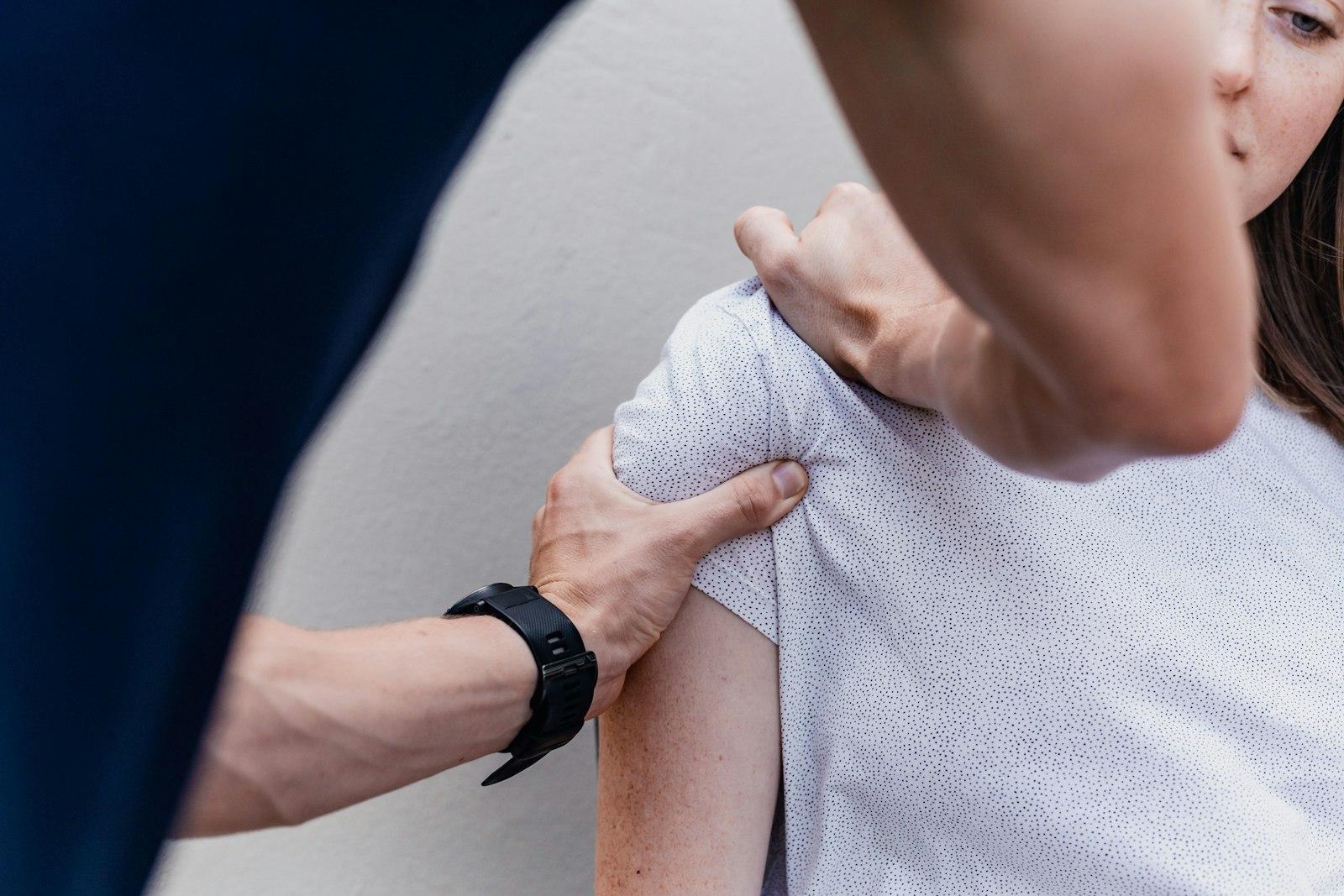
A video in which you mobilise a real patient’s shoulder looks more authentic than any stock photo. Legally, however, it shows two things: the image of a person and the fact that they are being treated by you. Both fall under data protection and confidentiality.
- Obtain written, explicit consent that states the purpose (website, social media), the duration and the right to withdraw consent.
- Without consent: team members, models or shots in which nobody can be recognised.
- No before-and-after promises and no patient stories that guarantee recovery – what advertising allows is covered in the guide to physiotherapy advertising.
Checklist for your physiotherapy website
Check before going live:
- Impressum link in the footer of every page, including an email address
- Professional title “Physiotherapeutin”/“Physiotherapeut” with the awarding country
- MTD-Gesetz 2024 as the professional law, with a link to the RIS
- Optional: registration number in the Gesundheitsberuferegister and Physio Austria (if you are a member)
- Bezirkshauptmannschaft or Magistrat as the supervisory authority
- Offenlegung under § 25 MedienG
- Cost information: health insurance contract or non-contracted, reimbursement, private services
- Privacy policy matching your form, booking, videos and map
- No uploads of medical reports without a secure solution; data processing agreements concluded
- Consent for every recognisable patient in photos and videos
Your physiotherapy website with all mandatory pages
We build websites for physiotherapy practices with a ready-made Impressum, privacy policy, cost information and a cookie-free basic setup. Take a look at a free preview for your practice first.
A free preview of how your practice website could look, built by us.
Sources
- RIS – E-Commerce Act (E-Commerce-Gesetz), § 5
- RIS – MTD-Gesetz 2024, current version
- gesundheit.gv.at – Public health professions register (Gesundheitsberuferegister)
- RIS – Media Act (Mediengesetz), § 25
- RIS – ASVG, § 131 (reimbursement of costs)
- RIS – Telecommunications Act (Telekommunikationsgesetz 2021), § 165
- RIS – Accessibility Act (Barrierefreiheitsgesetz), BGBl. I Nr. 76/2023
- USP – Accessibility Act (BaFG)
- Datenschutzbehörde (Austrian Data Protection Authority) – Newsletter 4/2022 (Google Fonts)
- Physio Austria – national association of physiotherapists