Key points at a glance
- The basis is the licence to use the professional title under the Masseur- und Physiotherapeutengesetz (MPhG, the German Masseurs and Physiotherapists Act).
- To treat people with statutory health insurance you need approval under § 124 SGB V from the Arbeitsgemeinschaft (ARGE) of your federal state – with at least 23 m² of treatment space and mandatory equipment.
- Prices are set nationwide in the contract under § 125 SGB V, for example €29.63 for physiotherapy exercise (since 1 January 2026). You also need 60 continuing education points in four years.
- Without a prescription you may treat illness only with a sektorale Heilpraktikererlaubnis; the Blankoverordnung (open prescription) so far applies only to certain shoulder diagnoses.
- Physiotherapy is a liberal profession and, as medical treatment, exempt from VAT. Mandatory: the BGW, often pension insurance and, depending on the federal state, notifying the public health office.
This post is general information and does not replace legal or tax advice. Rules change – check details with your chamber, your professional association or your tax adviser.
Professional licence and legal form
Anyone who calls themselves “Physiotherapeutin” or “Physiotherapeut” needs the licence under § 1 MPhG. You receive it from the competent state authority after passing the state examination. The certificate is the most important document for your start-up: without it, no statutory insurance approval.
- Liberal profession: Physiotherapy (still called “Krankengymnasten” in the statute) counts as a liberal profession under § 18(1) No. 1 EStG (Income Tax Act). You pay no trade tax and need no trade registration.
- Solo or shared practice: Most start on their own. A partnership with colleagues is possible; every practice needs a professional lead who is registered with the ARGE.
- Law under reform: On 26 October 2026, the Federal Ministry of Health presented the draft bill for a Physiotherapy Professions Reform Act (PhyThBRefG). It mainly concerns training and does not provide for direct access for now. For your start-up, the MPhG still applies.
Statutory insurance approval under § 124 SGB V
Around nine in ten people in Germany have statutory health insurance. To treat them at the expense of their insurance fund, you need approval under § 124 SGB V (Fifth Book of the Social Code). In every federal state, an Arbeitsgemeinschaft (ARGE) – a joint body of the state associations of the health insurance funds and the substitute funds – decides on approval for all funds. You will find the approval offices at zulassung-heilmittel.de. The law sets three requirements:
- the training and licence to use the professional title,
- practice equipment that ensures appropriate and economical care,
- acceptance of the contracts under § 125 SGB V.
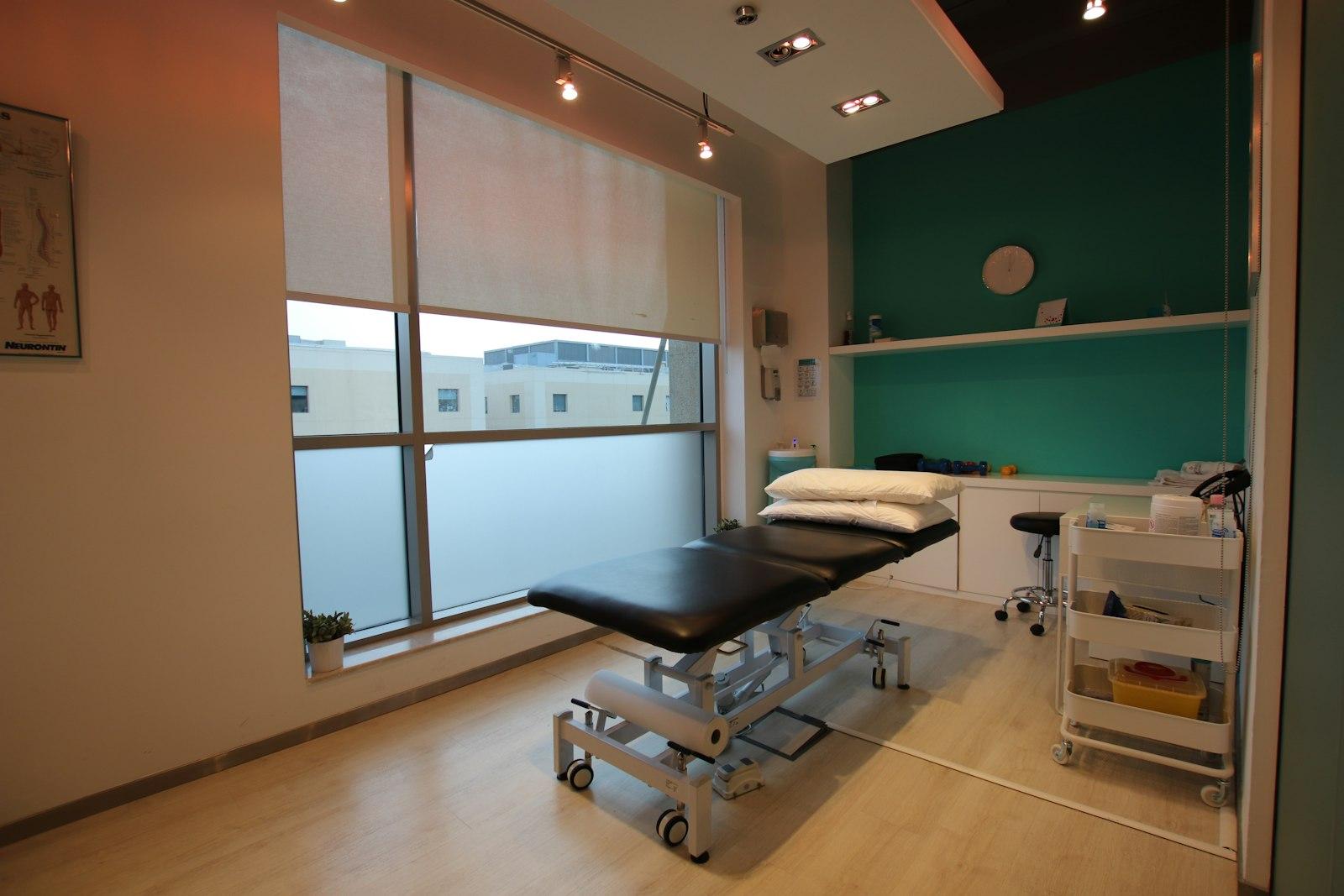
What “practice equipment” means in detail is set out in Annex 5 (approval requirements) to the contract under § 125 SGB V. Since August 2021, the requirements are found there and no longer in the former approval recommendations.
| Requirement | Value |
|---|---|
| Total treatment space | at least 23 m² |
| Of which treatment areas | one of at least 15 m², one of at least 8 m² |
| Each additional therapist working at the same time | an additional 8 m² or more |
| Ceiling height | at least 2.40 m clear height |
| Equipment-based exercise therapy (KGG) | an additional 30 m² or more, plus 4 m² per extra machine |
| Walk-through rooms | not allowed as treatment rooms |
| Hygiene | hand disinfection in every treatment room, easy-to-clean flooring |
Mandatory equipment includes two height-adjustable treatment tables with positioning aids, equipment for exercise therapy, timers, an emergency call system, and options for cold and heat therapy (at least one radiant heat device, such as infrared). Services such as KGG, electrotherapy or baths require additional equipment. Check the floor plan against Annex 5 before you sign the lease.

IK number and liability insurance
For billing you need an Institutionskennzeichen (IK) – an institution code under § 293 SGB V – for each location and therapy area. You apply for it free of charge at the SVI, the collection and distribution office of the Arbeitsgemeinschaft Institutionskennzeichen. The ARGE asks for the IK during the approval procedure, so apply early.
Neither the MPhG nor the framework contract prescribes professional liability insurance with a fixed sum insured. Still, don’t carry out a single treatment without it: a treatment error could otherwise ruin you personally. Ask your ARGE which proof it wants to see in the application.
Contract under § 125 SGB V: prices and duties
With your approval, you accept the nationwide contract under § 125(1) SGB V, concluded by the GKV-Spitzenverband (National Association of Statutory Health Insurance Funds) and the physiotherapy associations. It governs services, billing, continuing education and prices. There is nothing to negotiate: every practice receives the same rates.
| Code | Service | Price |
|---|---|---|
| X0501 | Physiotherapy exercise (KG), individual treatment | €29.63 |
| X1201 | Manual therapy (MT) | €35.59 |
| X0710 | Neurological physiotherapy (KG-ZNS) according to Bobath (adults) | €47.06 |
| X0201 | Manual lymphatic drainage, 45 minutes | €53.94 |
| X0106 | Classic massage therapy (KMT) | €21.63 |
| X9950 | Home visit including travel allowance | €22.78 |
- Co-payment: Adult patients pay 10% of the costs plus €10 per prescription. You collect this amount and it is offset against your claim to the insurance fund.
- Continuing education: 60 points in four years, ideally 15 per year (Annex 4). One point equals 45 minutes. Courses on marketing, billing or wellness don’t count.
- Certificate services: For MT, KG-ZNS, lymphatic drainage or KGG you need the corresponding further training and must report it to the ARGE before billing.
Prescription, Blankoverordnung and direct access
You provide insured services on a doctor’s prescription under the Heilmittel-Richtlinie (therapeutic products directive) of the G-BA (Federal Joint Committee). Treatment must begin within 28 calendar days of issue, or within 14 days if treatment is urgent (§ 15 HeilM-RL). Check every prescription before the first session – formal errors are otherwise at your expense.
- Blankoverordnung (§ 125a SGB V): Since 1 November 2024, doctors can issue an open prescription for certain shoulder diagnoses in diagnosis group EX. You then decide on the therapy, amount and frequency yourself – and bear responsibility for cost-effectiveness. Whether further indications will be added is still open in November 2026.
- No direct access: Without a prescription the insurance fund doesn’t pay. The 2026 reform draft does not provide for direct access for now either.
- Sektoraler Heilpraktiker Physiotherapie: With this licence under the Heilpraktikergesetz (Alternative Practitioners Act), limited to physiotherapy, you may treat self-paying patients without a prescription. You apply at the public health office; the procedure (assessment based on records or an oral exam) varies by federal state.
Private patients and self-payers
Privately insured patients, people entitled to Beihilfe (state allowance for civil servants) and self-payers receive an invoice from you. There is no official fee schedule for physiotherapy; you set your prices yourself. But point out that insurers and Beihilfe only reimburse up to their maximum amounts – federal Beihilfe, for example, under Annex 9 of the Bundesbeihilfeverordnung. Transparent prices on your website save you many questions.
Registrations: tax office, public health office, BGW, pension
Tax office
Within one month of starting, complete the tax registration questionnaire via ELSTER. You receive a tax number and report your profit with a simple cash-basis income statement (EÜR).
Public health office
In many federal states you must notify the Gesundheitsamt (public health office) when you start practising. The rules are in the state laws on the public health service – ask your local Gesundheitsamt.
BGW (accident insurance)
Register your practice within one week with the BGW, the statutory accident insurer for health and welfare services (§ 192 SGB VII). As a self-employed physiotherapist you are usually compulsorily insured there yourself.
Pension insurance
If you don’t regularly employ staff subject to compulsory insurance, you are subject to compulsory pension insurance as a self-employed physiotherapist under § 2 sentence 1 No. 2 SGB VI. Register with the Deutsche Rentenversicherung within three months.
Selling products
If you sell resistance bands, foam rollers or supplements, that is a commercial activity: trade registration, VAT, separate bookkeeping. In a partnership it can even make the whole practice liable to trade tax.
Premises, home visits and working models
| Model | Advantages | Watch out for |
|---|---|---|
| Own practice with approval | full freedom, all statutory patients | meet Annex 5, high start-up costs |
| Freelancing in a practice | hardly any investment | avoid bogus self-employment, consider a status assessment |
| Home visits from your own practice | in demand among older and immobile patients | flat fee X9950 barely covers travel time |
| Private practice without approval | free pricing, less paperwork | private patients and self-payers only |
Annex 5 describes approval for a practice with minimum floor space; for home visits you take the necessary equipment with you. The contract does not provide for a pure home-visit practice without premises – clarify special cases with your ARGE in advance. How to find and finance premises is shown in the guide to opening a practice in Germany.
How patients find you
Prescription in hand, many patients search on their phone for “physiotherapy near me” – and choose the practice with the earliest free appointment. Add to that recommendations from orthopaedists, GPs and surgeons.
- Website with areas of focus: one page per service, such as “manual therapy”, “lymphatic drainage” or “physiotherapy after knee surgery”. What is allowed is covered in our post on advertising physiotherapy in Germany.
- Mandatory information: a legal notice (Impressum) with your statutory professional title, the country where it was awarded and the professional regulations – see mandatory information for physiotherapy websites and the imprint generator.
- Google profile: opening hours, photos, home-visit area and genuine reviews – more in our posts on the Google Business Profile and local SEO.
- Inform doctors: A short visit with a flyer and your free capacity often works better than advertising. Money or benefits for referrals are off limits.
Websites for physiotherapy practices
Example websites with services, team, self-payer prices and online booking – ready to launch.
Roadmap: eight steps to your own practice
From the idea to your first insured treatment
- Have your MPhG licence and further training certificates (MT, MLD, KG-ZNS, KGG) ready
- Check premises against Annex 5: 23 m² treatment space, 2.40 m ceiling height, no walk-through rooms
- Order mandatory equipment, draw up a hygiene plan
- Apply for an IK at the SVI
- Apply for approval at the ARGE of your federal state
- Take out liability insurance, register with the BGW and pension insurance
- Inform the tax office (tax registration questionnaire) and, if required, the public health office
- Get your website, Google profile and billing software ready
Sources
- Gesetze im Internet – § 1 MPhG
- Gesetze im Internet – § 124 SGB V (approval)
- Gesetze im Internet – § 125a SGB V (Blankoverordnung)
- GKV-Spitzenverband – physiotherapy contracts under § 125 SGB V
- GKV-Spitzenverband – Annex 5: approval requirements for physiotherapy
- GKV-Spitzenverband – Annex 2: remuneration agreement from 1 Jan 2026
- GKV-Spitzenverband – Annex 4: continuing education
- G-BA – Heilmittel-Richtlinie
- Approval offices for therapeutic services (ARGEn of the federal states)
- Gesetze im Internet – § 4 UStG
- Gesetze im Internet – § 2 SGB VI
- Gesetze im Internet – § 192 SGB VII
- vdek – draft bill PhyThBRefG (27 Oct 2026)